

Writing in 1953, Robert Nisbet defined alienation as:
“The state of mind that can find a social order remote, incomprehensible, or fraudulent; beyond real hope or desire; inviting apathy, boredom, or even hostility.” The alienated individual “not only does not feel a part of the social order; he has lost interest in being a part of it.”
Alienation (from the Latin alienus, or ‘of another place or person’) is a term familiar in the common lexicon. Still, this has not prevented myriad interpretations (some contradictory) in the scholarly literature. Alienation can be used to describe both people and groups. We can speak of an individual experiencing alienation (feeling ostracized or alone, detached from those around them), and also characterize a society or polity in which many find themselves to be thus afflicted. In the following passages I begin to describe my theory of alienation as a sociopolitical phenomenon—the felt sense of a widening chasm between individuals and society.
It’s helpful to begin with a psychological understanding of people vis-à-vis the groups they associate with—and one step further, intergroup relations—and I rely heavily here on two related research streams from the mid-20th century psychology literature: Social identity theory and self-categorization theory. The overarching lesson of social identity theory is that an individual’s sense of self is derived through their membership in affiliative groups. We learn who we are through the differentiation of the ingroup from the outgroup. The mere presence of groups begins the process of drawing boundaries.
I use social identity theory to predict that individuals will increasingly differentiate between in- and out-groups as they withdraw from (or find themselves apart from) society writ large; the need to make sense of the self prompts individuals to “fall back” to more proximal identities (e.g. partisan, racial, ethnic, or regional) as a compensatory strategy to reduce the psychological stress of not belonging. This may in turn further ostracize the individual from the relevant superordinate group identity (the nation as a whole, for example).
It’s important to note that social identity theory is wholly distinct from the contemporary discourse on “identity politics” — the former is innate and intrinsic to human sociality; the latter is chiefly polemical and pejorative.
To wit, I expect that alienated Americans: 1) are disillusioned by the state and (chiefly public) institutions, both of which are viewed cynically and with suspicion; 2) experience a sense of social distance from the surrounding community (be it the nation as a whole or another salient superordinate group); 3) perceive in society a steady erosion of moral norms, contributing to perceptions of societal conflict and moral incertitude or decay.
Causes
To the query of what precipitates alienation, then, the answer appears manifold. There are economic, social, and political factors that often appear associated and antecedent to alienation, such as: Rising income and wealth inequality and the accompanying decline in comparative life satisfaction for most people in contrast to those at the very top; long-term processes like the weakening of workers unions, deindustrialization, and globalization which increase the precarity of ordinary citizens’ lives and livelihoods; government unresponsiveness to constituents1 and regulatory capture; and acute political developments (for example, rapid immigration or the growing political influence of previously marginalized groups). Alienation as a process is likely compounded by present-day political sorting and polarization, two trends driving social divisions today.23
The measurement strategy I employ in later empirical analyses relies on the assumption that as alienation increases so do perceptions of moral conflict, decline, and incertitude. This expectation draws from Émile Durkheim’s work on the related concept of anomie, or the experience of moorlessness and the loss of societally prescribed rules and norms of conduct. As the alienated individual further withdraws from society, they grow more closely to resemble that affliction which Durkheim suggested led to the individual’s suicide.4
I suggest that one consequence of alienation is the adoption of a perspective of society oriented around groups; that is, focused more on intergroup relationships and competition as moral conflict grows more salient in the mind of the alienated individual. This leads to such phenomena as moral disengagement, or the holding of views that rationalize derogating or harming opponents5. As Jim Morrison once wrote: “People are strange when you’re a stranger; faces look ugly when you’re alone."
Consequences
A multitude of problems can arise when an individual comes to lack meaningful social relationships. The same can be said of attachment to social groups, and, likewise, society wholesale. When the individual is deprived of a place in society, their sense of self, of belonging, of understanding the world becomes less sure. This extends equally to the social and political domains.
Alienation can be thought of as one consequence of the psychological distress brought on by chronic malnourishment of the fundamental human need to belong.6 This want may occur at the level of individuals, e.g. interpersonal relationships, or at the level of groups, between the individual and society or between the individual’s relevant social groups and society (the nation as a whole). Understood fundamentally as a distressing psychological state, alienation can begin to be talked about as a biological or evolutionarily induced response to the loss of social ties.
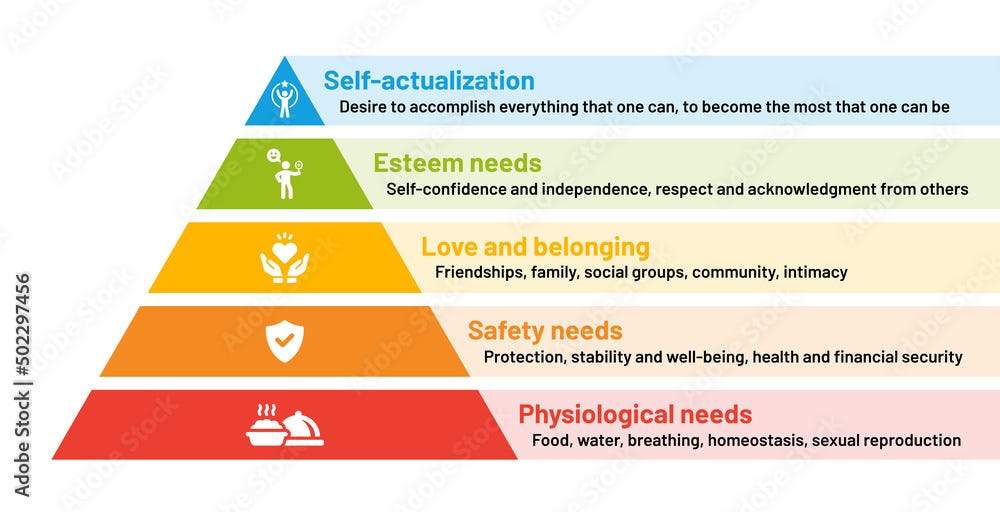
Under Maslow’s 1943 hierarchy of needs7, the desires for belonging and esteem comprise the middle portion of human needs, after the most basic for food, shelter, and safety. But a body of evidence today suggests that these ‘secondary’ psychological needs are no less crucial for individuals to thrive.8 The alienated individual today is less sure of their environment and which social groups occupy it. The study of alienation is the study of what happens when Maslow’s hierarchy is hollowed out — or when Colonel Kurtz goes upriver.
We’re covering a lot of territory, so bear with me here.
A basic process of primate sociality is the formation of small social groups, or “grooming cliques.” These coalitions of individuals form the basis for strong social ties – those close interpersonal relationships in which mutual grooming might arise. On our first date, with some hesitancy, I ventured to tell my now-spouse that she had food in her hair. Thus began the formation of a strong social tie rooted in mutual trust and aid. The growth of such dyadic (meaning one-on-one) relationships, typically forming hierarchically structured small groups of individuals, are thought to help primates navigate life living in close proximity to others. Primate behavioral specialist Robin Dunbar writes that such coalitions
“essentially allow primates to manage a fine balancing act between keeping other individuals off their backs while at the same time avoiding driving them away altogether and thereby losing the benefits for which the groups formed in the first place.”
Dunbar calls this evolutionary pressure toward sociality the “social brain hypothesis.”9 Primates, universally among them and unique to their order, are social animals first and foremost. But we also do not allow just anyone to join our grooming circles. It is prudent to be cautious in the selection of close kin and mates, as mistakes can prove costly.
An influential anthropologist and evolutionary psychologist at the University of Oxford, Dunbar examined the relationship between two long-standing curiosities of the primate order, and specifically of the anthropoids, a group that includes monkeys, apes, and humans: First, their inordinately large brains (consuming some 20 percent of caloric intake in homo sapiens); and second, their sociality and the resulting complexity of social life, found elsewhere only in whales and dolphins. Considering all anthropoids, Dunbar found a significant positive relationship between volume of the neocortex—the location of higher-order brain functions including sensory perception, cognition, spatial reasoning, and language—and social group size as observed in nature, wherein each individual knows one another and their respective relationships with others.
This social group size appears to represent an upper bound of sorts: a function of each anthropoid’s respective cognitive capacity to simultaneously maintain a given number of relationships of sufficient depth “that they can be relied on to provide unstinting mutual support when one of them is under attack” (ibid). In social network analysis, these relationships might be said to constitute strong (versus weak) ties. They are strong in the sense of the dyadic or paired relationship between individuals, but also because individuals have many mutual, overlapping ties – resulting in a close-knit web of stable social relationships.
In the 1998 paper establishing the social brain hypothesis, the coefficient of determination (or R2) between size of the nonvisual neocortex and mean group size is a heady 0.61. (In the social sciences, one can rarely expect such a strong association between two variables.) Extrapolating from this, homo sapiens’ nonvisual neocortex suggests a social group size of about 150, known today as Dunbar’s number. And indeed, this number reflects the approximate community size of traditional hunter-gatherer and small-scale horticultural societies extant by the Upper Paleolithic period some 50,000 years ago. This “magic number” continues to find widespread use in business, education, and military applications.
Suffice to say we have diverged from this ideal community size in the time since humanity gave up foraging. Small cities today tally hundreds of thousands of inhabitants, the US adult population is 332 million, and the world population stands at 8 billion, on its way to ten by 2056. A majority of that population owns a cellphone, opening up real-time access to one another no matter physical distance. In 2011 Pew found that the average American had 634 “social connections”—online and off. These represent a “handful of very close social ties and a much larger number of weaker ties.”10 Technology today allows us to maintain contact with individuals we’ll never meet or interact with again. But some argue these weaker connections are inadequate toward satisfying an individual’s need for sociability. An individual may have hundreds or thousands of “friends” on Facebook and still no close connections to rely on or console.
As In Chimps So Too Humans
This is not to say that contemporary life precludes the formation of the same types of close, personal ties to family and friends as we understand formed the social networks of premodern man. Likewise, it is sufficient to say that modern advancements like the cell phone do not guarantee the presence of strong, close relationships. Primates of all species can face exclusion or expulsion from a social or familial group, often the result of competition for scarce resources (food or mates) or deviance from group norms (shirking, malevolence, or illness). In chimpanzees, adolescent males are pushed toward the periphery of the group by more aggressive adult males, until they mature and become reintegrated members of adult male society.11 This exclusion is a rite of passage; a necessary step in maturation for male chimpanzees. Humankind’s ability to exclude or punish is far greater.
Early studies of chimpanzees raised in isolation in captivity found them to become timid and withdrawn, evincing “stereotypies” like rocking, swaying, and thumbsucking; growing agitated and aggressive when introduced to novel objects (e.g. a ball or toy dog).1213 These behavioral effects of isolation have been witnessed in other species as well, including our own.1415
“Repeated exposure especially to unpredictable and inescapable stress can lead to learned helplessness in humans and nonhuman species, a state that is characterized by anxiety, inactivity and neophobia,” or the fear of novelty, write Reimers and colleagues, “as well as chronically increased cortisol values” (2007, p 428-9)
Or, in the case of social exclusion specifically, dysregulated cortisol patterns.1617 In sum, chronic psychological distress can have enduring effects on an individual’s physical and mental well being; particularly if experienced early in life.1819
As I wrote earlier, alienation is the product of feeling like you don’t belong. It may arise from insecurity about yourself vis-à-vis those around you (the experience of “imposter syndrome”) or uncertainty about how to behave in a given situation (feeling out of place). Baumeister and Leary call the need to belong a “fundamental human motivation.”20 The central conflict then is between the individual and society, and (of political interest) the point at which enough individuals in a population perceive themselves dispossessed such that we can say alienation becomes a societal affliction. So while depression or loneliness appear superficially similar, alienation stands as its own phenomenological concept—and the measurement strategy pursued subsequently is sensitive to this distinction. Alienation becomes increasingly politically significant the more the perception becomes chronic and widespread among some non-trivial proportion of the population, to the point that it can be said to sublimate into a collective consciousness—a shared perception or understanding—for the given group, and that group can be truly described as “alienated.”
Setting aside illness or forced solitude, the pool of alienation-inducing experiences in modern society is quite broad. Conflict can be thought of as a necessary component, either 1) at the level of the individual, where they may feel chronically unsure or stymied toward some pursuit (including group membership); 2) within or between relevant social groups vying for status or resources; or 3) at the mass societal level where rapid change can provoke uncertainty and perceptions of societal conflict in predisposed individuals. My focus for now centers mainly on the first condition. These mechanisms may operate independently or synergistically, and this association between alienation and views of societal conflict forms the basis for the measurement strategy I develop.
Alienation becomes politically salient at the point at which a significant enough proportion of the population is thusly afflicted. This is where I argue we find ourselves today.
This post is a rewritten excerpt from my 2023 dissertation “The Alienated American.”
All rights reserved. No portion may be reproduced in any form without written permission from the publisher or author, except as permitted by U.S. copyright law.
References1
Oliver, J. E., & Rahn, W. M. (2016). Rise of the Trumpenvolk: Populism in the 2016 Election. The ANNALS of the American Academy of Political and Social Science, 667(1), 189-206.
Iyengar, S., Lelkes, Y., Levendusky, M., Malhotra, N., & Westwood, S. J. (2019). The origins and consequences of affective polarization in the United States. Annual review of political science, 22, 129-146.
Mason, L. (2018). Uncivil agreement: How politics became our identity. University of Chicago Press.
Durkheim, Emile. (1897/2005). Suicide: A Study in Sociology. Glencoe, Illinois: The Free Press.
Kalmoe, N. P., and L. Mason. (2022). Radical American Partisanship: Mapping Violent Hostility, Its Causes, and the Consequences for Democracy. University of Chicago Press.
Fiske, Susan T. (2018) Social beings: Core motives in social psychology. John Wiley & Sons.
Maslow, A. H. (1943). A Theory of Human Motivation. Psychological Review 50, no. 4: 370–96.
Jetten, J., C. Haslam, and S. Haslam. (2012). The Social Cure: Identity Health and Wellbeing. Taylor & Francis.
Dunbar, R. I. M. (1998). The Social Brain Hypothesis. Evolutionary Anthropology: Issues, News, and Reviews 6, no. 5 (1998): 178–90.
Hampton, K., L. Sessions Goulet, and K. Purcell. (June 16, 2011). Social Networking Sites and Our Lives. Pew Research Center: Internet, Science & Tech (blog).
Goodall, J. (1986). The Chimpanzees of Gombe: Patterns of Behavior: Patterns of Behaviour. Cambridge, Mass: Harvard University Press.
McCulloch, T., and G. Haslerud. (1939). Affective Responses of An Infant Chimpanzee Reared in Isolation From Its Kind.
Menzel, E. W., R. K. Davenport, and C. M. Rogers. (1963). The Effects of Environmental Restriction upon the Chimpanzee’s Responsiveness to Objects. Journal of Comparative and Physiological Psychology 56, no. 1: 78–85.
Weiss, R. (1975) Loneliness: The Experience of Emotional and Social Isolation. New edition. Cambridge/Mass.: The MIT Press.
Beerda, B., Matthijs B. H., Schilder, J. A. R. A. M. van Hooff, and H. W. de Vries. (1997). Manifestations of Chronic and Acute Stress in Dogs. Applied Animal Behaviour Science. Behavioural Problems of Small Animals, 52, no. 3: 307–19.
Sapolsky, R. M. (2005). The Influence of Social Hierarchy on Primate Health. Science. (New York, N.Y.) 308, no. 5722: 648–52.
Dickerson, S. S., and P. M. Zoccola. (2013). Cortisol Responses to Social Exclusion. In The Oxford Handbook of Social Exclusion, 143–51. Oxford Library of Psychology. New York, NY, US: Oxford University Press.
Nicolson, N. A. (2004). Childhood parental loss and cortisol levels in adult schmen. Psychoneuroendocrinology 29.8: 1012-1018.
Schreier, H. M.C., M. B. Enlow, T. Ritz, C. Gennings, and R. J. Wright. (2015). Childhood Abuse Is Associated with Increased Hair Cortisol Levels among Urban Pregnant Women. Journal of Epidemiology and Community Health 69, no. 12: 1169–74.
Baumeister, R. F., and M. R. Leary. (1995). The Need to Belong: Desire for Interpersonal Attachments as a Fundamental Human Motivation. Psychological Bulletin 117, no. 3: 497–529.