
Ever since that gaudy golden escalator brought Donald Trump gliding down to his 2015 presidential announcement—where, foreshadowing the next eight years and counting of American politics, he labelled Mexican immigrants “criminals and rapists” before musing that some, presumably, are good people—the chattering classes in politics, media, and academia have underestimated the fatal attraction of “bread and circuses,” or panem et circenses. This phrase is attributed to the first-century CE Roman poet Juvenal and is used to describe the mollifying effects of the state providing cheap goods and spectacle to the public: Bribery and distraction in lieu of meaningful public policy. The free gifts bestowed by Trump have included direct payments (with his signature no less!) and ill-conceived tax breaks, while the spectacle has been the man himself, a despotic administration, and the bewilderment of the mainstream establishment. (One might consider the repeal of Roe and his judicial appointments—given their frequent nonseriousness as legal scholars—as just additional panem.)
Trump has continued to dominate the political landscape for a host of reasons, in spite of (or buoyed by) the lack of any political core to the man or semblance of a strategy during the campaign(s) or administration. Those who would be the political opposition (the Democratic Party) are stymied by their choice to repeat past failures with less extreme precursors (the Tea Party), strict allegiance to their wealthy and corporate donors — as well as the party’s general political ineptitude that stretches back decades. All of this disregarding the malfeasance of the Republican Party, failures of the political media, and erosion of public institutions that were thought to have checked the nation’s slide toward autocratic rule.
There is much to say, but today I wish to concentrate on the path ahead as voting formally begins for the 2024 presidential election. Odds are, we’re on track for another Trump administration. This post is being written on the eve of the Iowa caucuses, where the final Des Moines Register poll indicates a 28-point delta between support for Trump and his nearest rival, Nikki Haley. (Ron DeSantis and Vivek Ramaswamy remain in the running, but the Republicans have avoided a repeat of 2016, when a morass of primary candidates helped to win Trump the nomination.)
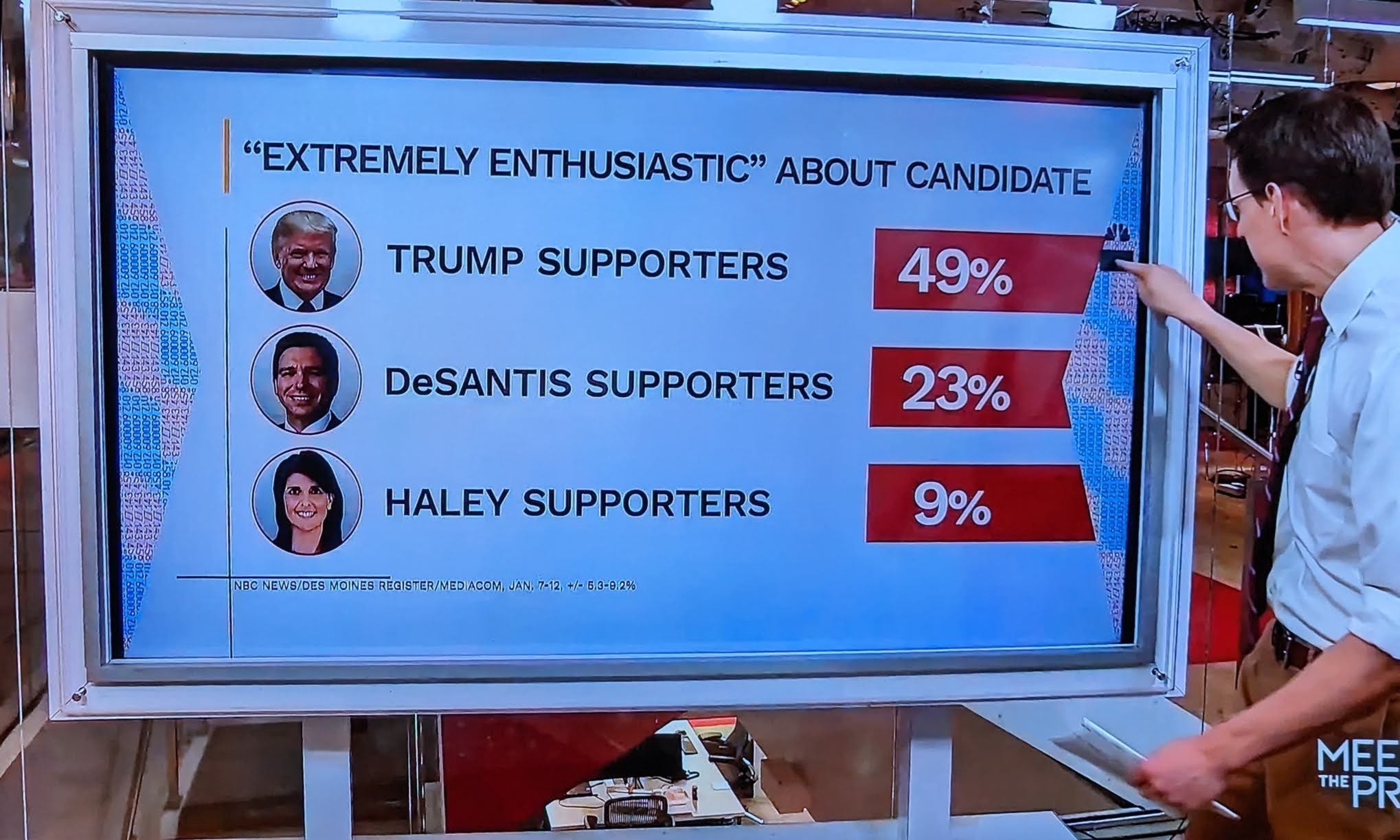
Find someone enthusiastic about a second Biden term.
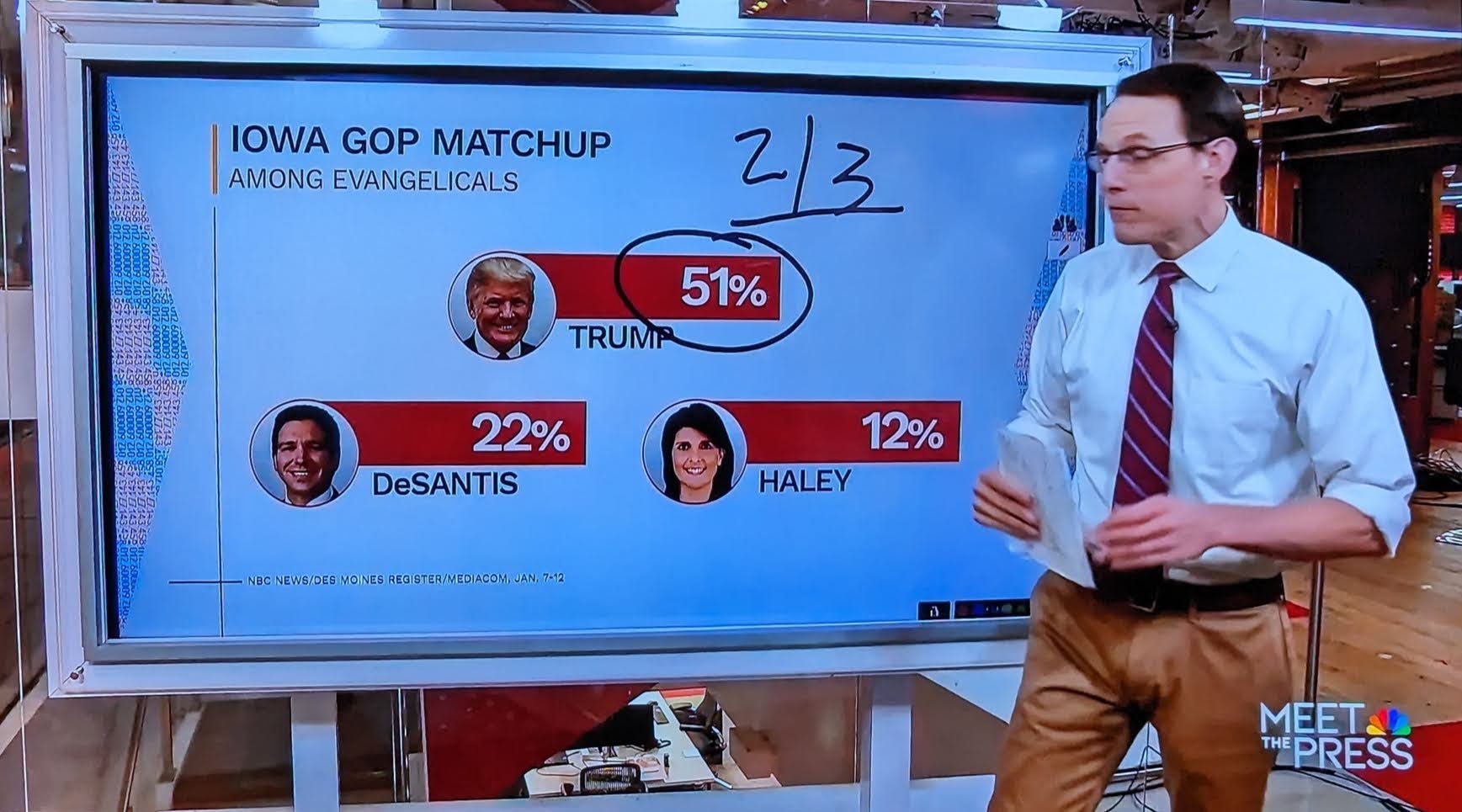
Trump has secured Evangelicals, and has made inroads with the college educated, younger voters, African Americans, and Hispanics, versus 2016/2020.
Somehow, the 2024 general election appears poised to lead inexorably to a repeat of 2020; a contest pitting two wildly unpopular aged white men. I believe the odds are slim that Trump’s many, many legal troubles prevent him from being on the ballot. The chances that a health issue sidelines one candidate or the other are greater, in my mind. But barring some unexpected, non-predictable event, I would say the ballots could be printed up today. And it pains me to say that Trump is possibly in a better position to overtake Joe Biden this go-around. I’m a perennially pessimistic person — but that negative outlook successfully anticipates the future more often than not today.
Following are a few of the considerations I’m factoring in to support this conclusion.
But first: Ignore the polls — for now
I’d like to mention what’s not driving my thinking. Surveys right now will tell us something about the primary races (although state-by-state primary polling is significantly less reliable than general election polling) but basically nothing about the margins next November. This includes the generic ballot (Democrat versus Republican), head-to-head (Trump versus Biden) matchups, and approval/disapproval surveys — sampling registered or likely voters. This isn’t because I dislike or don’t believe (read: understand) scientific polling, but rather because individuals’ sentiments in January have little bearing on how they will think eleven months from now. The past few years have thrown out many so-called “laws” that American politics scholars have invented, but basic, non-polling based predictive models of the presidential contest held up pretty well, actually.
For one, Emory’s Alan Abramowitz and his “Time for Change” model correctly predicted Trump’s win in 2016 in my view. This requires an explanation. Technically speaking, the model (at that time) used GDP in the second quarter, presidential approval mid-year, and an indicator variable noting the length of the incumbent party’s control of the presidency. This simple three-variable model predicted a Trump victory in 2016 in the popular vote. Abramowitz spent the leadup to that election walking back his prediction, in talks and interviews saying that he didn’t believe his own model. As we know, Hillary Clinton won the popular vote but lost in the electoral college. This outcome can occur due to the Senate’s malapportionment. But in an environment where essentially everyone predicted a drubbing, this model was more right than wrong.
Note: Abramowitz simplified his model to only consider mid-year presidential approval after 2016, claiming GDP and the incumbency advantage are not predictive due to heightened partisanship in our sharply divided age. (This is Debatable.) Helmut Norpoth of Stony Brook also predicted a Trump victory in 2016, factoring in results from early primary states. (This model in turn failed in 2020.) The takeaway here? Place your bets in a few months, based on approval or GDP, your call. Regarding the claim that incumbency no longer matters: 2024 will be confounding given that it’s likely to be in some sense a matchup between incumbents.
Now let’s go to the list!
Trump’s grip on the GOP. This deserves more explication than I’m presently prepared to deliver, but suffice to say: The Republican Party is Trump’s apparatchik to lose. This was in no way the case leading up to the 2016 election. To wit: Trump’s recent wishful thinking for a worsening economy in advance of November is one potentiality House Republicans might likely be able to achieve.
Redistricting and GOP voter suppression efforts. The 2024 election will be based on the 2020 census, which saw population loss in notably blue states (California, Illinois, New York) and big gains in some red states (Texas, Florida). Compounding matters, partisan redistricting (gerrymandering) on a state-by-state basis using the new census figures favored Republicans (due to a majority of state legislatures controlled by Republicans, and some Democratic-controlled bodies—New York—acquiescing to conservatives). Furthermore are measures introduced state-by-state to make voting more difficult, under the auspices of “election integrity.” Reduced numbers of polling places, restrictions to early and absentee voting, voter identification requirements — these changes all favor Republicans by making it more difficult to vote for younger, lower income, and non-white populations. Go figure.
The economy in the short term. Believe the ballyhoo: The economy is improving based on all the ordinary metrics. But the pandemic is still having pernicious effects, meaning indicators like GDP this year might not translate to the results we expect. Talking heads have been explicating the improved economy but pessimistic population by pointing out that a decline in the rate of inflation isn’t very visible or felt by consumers. Prices are still higher than they were, outstripping any wage growth some households might have seen. Interest rates, meanwhile, set by the Federal Reserve, are unlikely to return to the dramatic lows witnessed during the pandemic/the past decade. The stock market is hot but benefits few. Indeed, a lot of economic sizzle since the heart of the pandemic has served to only bring the country back to its pre-2020 baseline. The removal of pandemic-era safeguards (the moratorium on evictions) and end of emergency spending programs will have detrimental effects felt by voters. In the meantime, households are still accumulating debt (including notably the exorbitant amount of outstanding student loans the Biden administration once promised to alleviate). Traditional economic measures like GDP don’t do a good job of measuring the financial health of the average household — they were never intended to.
Longer-term economic and societal trends. More important than any of the preceding points are the long-term trends that have given rise to conservative populism and Trump & Co.’s cryptofascism. Real wage declines, manufacturing losses, and the hollowing out of the middle class are steady state trends dating to the late 1960s, as are soaring expenses like real estate, childcare, and education. The populists have a point; Trump’s rhetorical flourishes succeed because most American households really are worse off than a generation before. People are angry, and all the factors benefiting Trump in 2015 have only grown more dominate in the minds and lives of Americans. We are growing only more alienated and distant from government, and each other.
International affairs—e.g. wars in Ukraine and the middle east, other volatilities spurring migration (not the least of which, climate change)—appear at present to play into the authoritarian dynamic driving politics in the US and abroad.
Individuals gobsmacked by the 2016 election or Jan. 6 insurrection need to pay heed to history and resist the urge of Pollyannaish American exceptionalism. Maybe something changes. But I doubt it.